


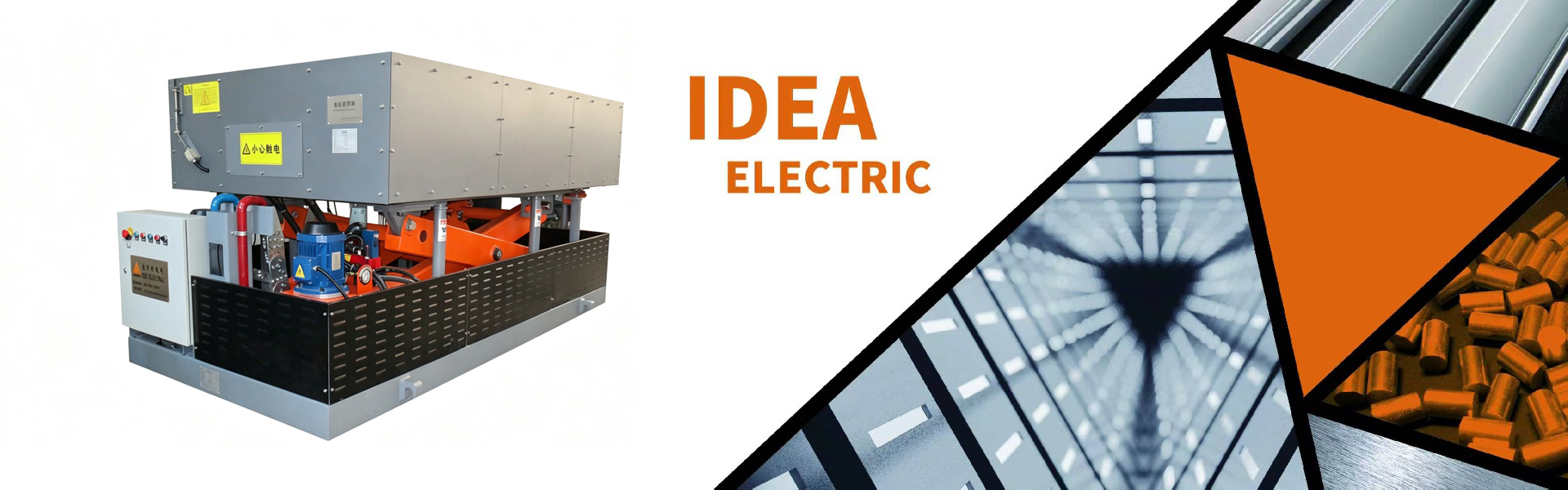


Electromagnetic Stirring Casting System
Electromagnetic stirring casting breaks through the technical bottleneck of uniform solidification of high-alloyed and large-volume metal melts, realizing fine-grain and homogeneous casting of high-strength aluminum alloys. It significantly refines and homogenizes grains, and greatly improves the co
产品介绍
Electromagnetic stirring casting breaks through the technical bottleneck of uniform solidification of high-alloyed and large-volume metal melts, realizing fine-grain and homogeneous casting of high-strength aluminum alloys. It significantly refines and homogenizes grains, and greatly improves the coordinated deformation capacity and mechanical properties of products.
National Toll-free Hotline: 400-002-0311
Product Introduction
OPERATIONAL PRINCIPLE
Electromagnetic stirring casting generates a strong alternating magnetic field through current, which penetrates multi-layer medium barriers to drive the flow of molten metal inside continuous casting billets. By controlling the flow state, it optimizes the internal structure, composition distribution, melt purity and surface quality of casting billets. Featuring non-contact effect and uniform distribution, the electromagnetic field is especially suitable for high-temperature and special working scenarios. Production practice shows that electromagnetic stirring has remarkable effects on improving columnar crystals, bridging and pinholes, expanding equiaxed crystal zones, reducing composition segregation, and alleviating or eliminating center porosity and center shrinkage cavities.

ELECTROMAGNETIC STIRRING CASTING CLASSIFICATION

PRODUCT ADVANTAGES
1. High casting quality. Refined grains and uniform microstructure reduce volume shrinkage and hot cracking tendency, eliminate matrix porosity, and greatly improve mechanical properties.
2. Low and fast solidification shrinkage improves productivity and shortens the process cycle. It also enhances the dimensional accuracy of formed parts with small machining allowance, realizing near-net forming.
3. Wide range of formable alloys. Non-ferrous alloys include aluminum, magnesium, zinc, tin, copper and nickel-based alloys; ferrous alloys include stainless steel and low-alloy steel.
4. Capable of manufacturing metal matrix composite materials. The high viscosity of semi-solid metal enables alloying of metals with large density differences and low solid solubility, and effectively mixes different materials to form new composite materials.
5. Low forming temperature (aluminum alloy forming temperature can be reduced by more than 120℃), achieving significant energy savings.
6. Prolonged die service life. The shear stress of low-temperature semi-solid slurry during forming is three orders of magnitude lower than that of traditional dendritic slurry, ensuring smooth mold filling, low thermal load and reduced thermal fatigue.
7. Reduce pollution and potential safety hazards by avoiding high-temperature molten metal operating environment.
8. Low deformation resistance enables homogeneous processing with low force, facilitating the forming of difficult-to-machine materials.
9. Compatible with computer-aided design and manufacturing, improving production automation.


